Importance: Chronic low back pain (cLBP) is associated with reduced gait speed and other gait quality impairments. Fear-avoidance and pain catastrophizing impact movement in cLBP, but their specific impact on gait quality is unknown.
Objective: This study aimed to determine associations between fear-avoidance or pain catastrophizing and gait quality in cLBP.
Design: This was a cross-sectional study.
Setting: This study occurred at a university.
Participants: There were 500 individuals (56.6 [SD = 16.5] years old.; 311 female) with cLBP.
Interventions: Participants completed the Fear-Avoidance Beliefs Questionnaire – Physical Activity (FABQ-PA) and 6-item Pain Catastrophizing Scale (PCS-6). Participants were divided into high and low fear-avoidance subgroups based on an established FABQ-PA cutoff (>14).
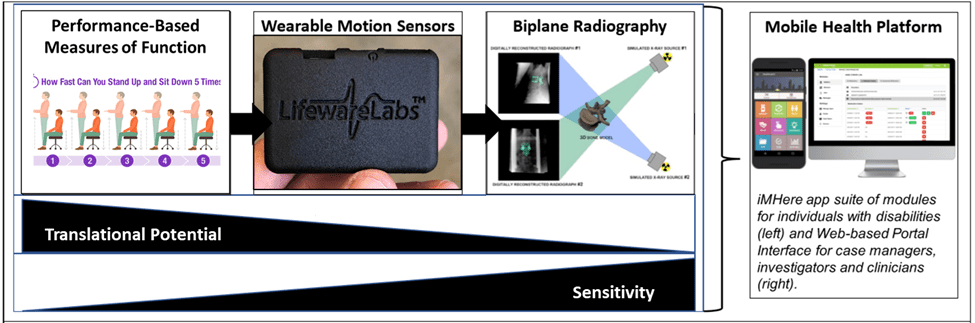
Main outcomes and measures: Gait speed was measured during a 4-meter walk test, while step time average, step time variability, and symmetry were derived from a lumbar inertial measurement unit worn during a 2-minute walk test. Multiple linear regression models were used to determine relationships between fear-avoidance or pain catastrophizing and gait quality. T tests were used to determine gait quality differences between high versus low fear-avoidance subgroups.
Results: High fear-avoidance was associated with reduced gait speed (B = -0.0039), but pain catastrophizing was not. The high fear-avoidance subgroup had slower gait speed (mean difference = 0.05 m/s), longer step time (mean difference = 0.02 s), and higher step time variability (mean difference = 0.004 s) compared to the low fear-avoidance subgroup.
Conclusions: Fear-avoidance is associated with slower gait speeds, even after adjusting for demographics, pain, and disability. The established FABQ-PA cutoff is robust in detecting gait differences between high versus low fear-avoidance subgroups.
Relevance: It may be important to consider fear-avoidance in the delivery of multi-modal interventions to address gait impairments. Future studies are needed to determine the impact of addressing fear-avoidance alongside traditional gait interventions in cLBP.